

The Hidden Security Challenge Inside Smart Buildings
The smarter a building becomes, the more intentional its wireless infrastructure needs to be.
A smart building is not one network. It is many networks operating in the same physical space, often designed by different teams, installed at different times and maintained under different priorities.
That is where the security conversation starts to change.
During October Cybersecurity Awareness Month, much of the focus naturally falls on passwords, phishing, endpoint protection and cloud access. Those issues matter. But inside connected buildings, security also has a physical layer. Wireless signals move through walls. Devices appear above ceilings, inside risers, behind panels and across tenant spaces. Operational systems that once stood alone now depend on wireless connectivity to report, respond and automate.
A building can have carrier cellular, public safety radio, Wi-Fi, private wireless, access control, smart lighting, sensors, cameras, building automation systems and tenant networks all sharing the same built environment. Each layer may be valid. Each may serve a critical purpose. Together, they create a need for more deliberate infrastructure design.
RAN Wireless approaches this from the engineering side. The role is not to act as a cybersecurity consultancy or threat-monitoring provider. The role is to help design, model, test, validate and improve the in-building wireless foundation that connected systems depend on.
Security starts long before monitoring tools see traffic. It starts with knowing what is in the building, where signals travel, who needs access and how the wireless layer supports the systems above it.

Smart building security has moved beyond the IT room
Traditional building systems were often isolated. HVAC controls, lighting, elevators, fire systems and access control could operate on dedicated wiring or closed networks. That model has changed.
Modern properties rely on connected systems for:
Energy management
Occupancy analytics
Indoor navigation
Mobile access credentials
Video surveillance
Smart parking
Asset tracking
Emergency communications
Tenant experience applications
Remote monitoring and maintenance
Many of these systems use some form of wireless connectivity. Some connect through Wi-Fi. Some use cellular. Some rely on private LTE or 5G. Others use Bluetooth Low Energy, Zigbee, Z-Wave, LoRaWAN or proprietary RF links. Public safety radio and Distributed Antenna Systems also occupy the in-building wireless environment, serving a separate but essential function.
This mix turns the building into a communications ecosystem.
That ecosystem can support faster service, better visibility and more efficient operations. It can also introduce blind spots when infrastructure grows without coordination. A sensor network added by one vendor may share space with tenant Wi-Fi. A carrier system may need pathways through areas controlled by another stakeholder. An access control upgrade may depend on wireless coverage in back-of-house spaces that were never part of the original design.
When teams make these decisions in isolation, the building may still function. But the risk profile becomes harder to understand.
The hidden security challenge is coordination
The hidden security challenge inside smart buildings is not only the number of devices. It is the lack of a single view across wireless systems, physical infrastructure and operational ownership.
A commercial property may involve developers, owners, facility teams, enterprise IT, telecommunications operators, contractors, system integrators, public safety officials and tenants. Each group may manage a piece of the connected environment. Each may have its own requirements, timelines and standards.
That shared environment creates practical questions:
Which wireless networks are approved for building systems?
Which devices are connected, and where are they installed?
Which rooms, risers and pathways support wireless infrastructure?
Who can access antennas, head-end equipment, network closets and cabling?
How far do wireless signals extend beyond intended areas?
What happens when a tenant modifies its space?
How are changes documented after installation?
These are infrastructure questions with security consequences.
A well-secured application can still depend on a poorly documented wireless path. A building automation system can have strong credentials, yet still sit on infrastructure that no one has recently surveyed. A smart lock system can use encryption, yet still fail if coverage is inconsistent near stairwells, garages or service entrances.
Good security depends on good engineering inputs. That includes coverage maps, equipment locations, signal measurements, pathway documentation, validation testing and change control.
Wireless design affects access in ways that are easy to miss
Wireless coverage is often discussed in terms of performance. Can users make a call? Can sensors report data? Can first responders communicate? Can guests connect?
Those are necessary questions, but they are not the only ones.
A wireless signal does not respect lease lines, walls or intended use zones. RF energy reflects, attenuates and propagates according to building materials, antenna placement, frequency, power levels and the surrounding environment. Glass, concrete, metalized insulation, elevator cores and low-emissivity windows all shape coverage.
That means wireless design also affects access.
Coverage that spills too far beyond a building perimeter may create unwanted exposure. Coverage that fails inside mechanical rooms or stairwells can affect operations and safety. Overlapping systems can create interference or make troubleshooting harder when a device behaves unexpectedly. Poorly placed antennas can leave critical areas dependent on marginal signal strength, leading teams to add temporary equipment later.
Temporary additions tend to become permanent.
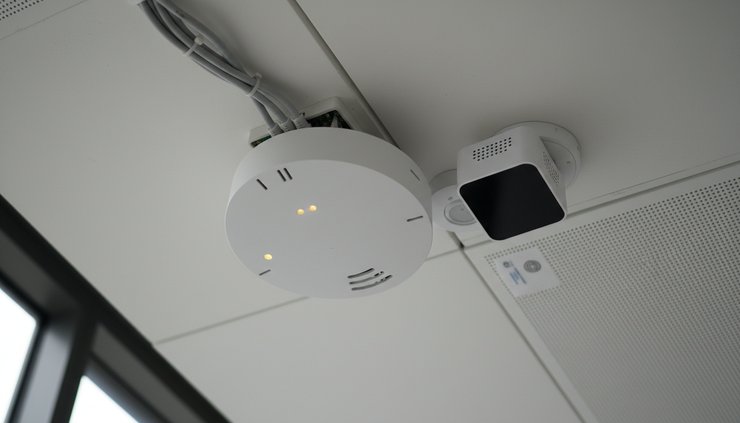
That is how unmanaged infrastructure accumulates. A repeater appears. A gateway is mounted above a ceiling tile. A small antenna is added in a closet. A vendor installs a device to solve one urgent issue, but no one updates the building record.
No single change may seem significant. Over time, the wireless environment becomes harder to govern.
Smart buildings need a wireless inventory that stays current
Most security programs start with asset visibility. The same principle applies to the wireless layer.
A smart building should have a current record of the wireless systems that support daily operations. That record does not need to replace cybersecurity asset management tools. It should complement them with infrastructure-specific information.
A useful wireless inventory may include:
Wireless technologies in use across the property
Antenna and access point locations
Head-end and equipment room locations
Cabling routes and riser dependencies
Carrier, tenant and building-owned systems
Frequencies or bands used where documentation is available
Coverage expectations by area
Known dead zones or weak signal areas
Recent survey and test results
Responsible stakeholders for each system
This kind of record helps teams make better decisions during upgrades, tenant fit-outs, incident response, renovations and system replacements.
For example, a facility team planning a smart lighting expansion may discover that the proposed gateway locations share ceiling space with other RF systems. An enterprise IT team may need to understand whether a building automation controller depends on Wi-Fi, cellular or a separate sensor network. A telecommunications operator may need to coordinate around existing DAS infrastructure. A network architect may need survey data before deciding how to support private wireless.
The inventory is not just documentation. It is a control point for future change.
Segmentation is stronger when infrastructure supports it
Network segmentation is often treated as a logical design issue. VLANs, firewalls, authentication policies and access rules matter. Yet segmentation can be weakened by physical and wireless design choices.
Building systems should not be treated as ordinary user devices. Access control panels, cameras, environmental sensors and automation controllers have different risk profiles and often different life cycles. Some are managed by facilities. Some are managed by IT. Some are maintained by outside vendors. Some may stay in service for many years.
The wireless foundation should support those realities.
That may mean separating building operations traffic from guest access. It may mean planning private wireless for certain operational uses. It may mean designing Wi-Fi with clear service set identifiers, authentication models and coverage zones. It may mean placing gateways in secured areas instead of convenient but exposed locations.
RAN Wireless can support this work by contributing RF engineering, predictive modeling, surveys, testing and validation to the broader design process. Those inputs help cybersecurity, IT, facilities and telecommunications stakeholders understand what the physical wireless environment can support.
The best segmentation plan is easier to carry out when the building has been measured, modeled and documented.
Public safety and smart building connectivity must be planned together
Smart buildings also need to support emergency communications. Public safety radio coverage has its own requirements, stakeholders and code-driven considerations. It should not be treated as an afterthought or squeezed into a building only after other connected systems are in place.
A public safety DAS serves a different purpose than tenant Wi-Fi or commercial cellular coverage. It supports first responders when conditions may be difficult and time-sensitive. Its infrastructure, power, survivability and testing requirements can differ from other wireless systems.
At the same time, public safety systems still share the physical building. They may require riser space, equipment rooms, antennas, pathways and coordination with other infrastructure. That means public safety planning belongs in the same early conversations as smart building connectivity.
When developers and design teams wait too long, conflicts become more likely. Pathways fill up. Equipment rooms get assigned. Ceiling space becomes crowded. Tenant improvements complicate access. Retrofitting becomes harder than planning.
Preparedness in connected buildings is engineered before it is needed. That applies to safety, connectivity and the wireless conditions that support both.

The physical layer is part of the security posture
Many wireless security issues begin with physical access.
Equipment rooms, telecom closets, roof areas, risers and ceiling spaces can contain critical infrastructure. If those spaces are poorly controlled, the systems inside them become easier to disturb, modify or bypass. Even accidental changes can create risk.
A contractor moving conduit may affect antenna performance. A tenant build-out may block signal paths. A ceiling renovation may relocate equipment without updated testing. A new wall system may reduce coverage in a service area that supports access control or building automation.
Physical change is constant inside active buildings. Security-aware wireless design recognizes that change and plans for it.
This includes:
Clear labeling for critical infrastructure
Controlled access to telecom and equipment spaces
Coordination before renovations or tenant improvements
Post-change RF testing where coverage matters
Documentation updates after moves, adds or changes
Repeatable acceptance tests for new systems
These practices are practical. They do not require every facility professional to become a cybersecurity expert. They require teams to treat wireless infrastructure as a critical building system, not as a convenience added at the end.
Predictive modeling is not a replacement for field validation
Predictive RF modeling helps teams plan wireless systems before installation. It can estimate how signals will behave based on floor plans, materials, antenna locations and power levels. For new construction, major renovations and complex venues, that early planning can prevent costly surprises.
But buildings do not always behave exactly as drawings suggest.
Materials change. Tenants modify layouts. Mechanical systems fill ceiling space. Furniture, people and equipment affect signal conditions. For that reason, field surveys, testing and validation remain essential.
A practical process often includes:
Designing from accurate building data
Floor plans, material assumptions and system requirements shape the model.
Reviewing the design with stakeholders
IT, facilities, ownership, operators and integrators need to understand dependencies.
Testing after installation
Measurements confirm whether the system performs as intended.
Documenting results
Test data gives future teams a baseline for troubleshooting and change planning.
Repeating validation after major changes
Renovations, tenant turnover and system expansions can alter RF conditions.
This process supports reliability. It also supports security by reducing unknowns.
Unknown infrastructure is difficult to protect. Measured infrastructure is easier to govern.
Smart building projects need shared ownership from the start
No single team owns every layer of a smart building. That is why early coordination matters.
Developers may focus on marketability, code compliance and long-term asset value. Building owners may focus on operating performance and tenant experience. Facility managers may focus on reliability and maintainability. Enterprise IT may focus on network policy, identity and risk. Telecommunications operators may focus on carrier-grade performance. Network architects may focus on scalability and separation. Engineering teams may focus on whether the physical design can support the goal.
The building benefits when those perspectives meet before final decisions are made.
For smart building security, early coordination should address:
Which systems are mission-critical
Which wireless technologies each system uses
Which areas require guaranteed coverage
Which spaces require restricted equipment access
How tenants can add systems without creating conflict
How documentation will be maintained
How testing will prove that requirements were met
RAN Wireless fits into this process as a telecommunications and RF engineering partner. Its work in in-building wireless infrastructure, DAS, wireless network design, predictive RF modeling, surveys, testing, validation, and optimization supports the foundation that connected buildings rely on.
That foundation does not replace cybersecurity policy. It gives cybersecurity and operations teams a clearer, more dependable environment to protect.

A security-aware wireless strategy starts with practical questions
Smart buildings will keep becoming more connected. That is not a temporary trend. The value of automation, data, and mobile access is too significant for owners and operators to ignore.
The question is whether the wireless infrastructure is being planned with the same care as the systems that depend on it.
A security-aware wireless strategy starts with practical questions:
What networks exist in the building today?
Which systems depend on wireless connectivity to function?
Where are the antennas, gateways, cabling and head-end systems?
What spaces are controlled, shared or tenant-managed?
Where does coverage extend beyond its intended area?
What happens when a device, system or tenant changes?
Who validates performance after installation?
Who updates the record?
These questions do not solve every cybersecurity concern. They make the environment more knowable. That is a meaningful step.
For October Cybersecurity Awareness Month, smart buildings deserve attention not only at the software layer, but also in the ceilings, risers, stairwells, mechanical spaces and equipment rooms where wireless infrastructure lives.
The smarter a building becomes, the more intentional its wireless infrastructure needs to be. Security, reliability, and performance all improve when the wireless layer is designed, tested, and documented as part of the building’s core infrastructure.


Comments