

When Connectivity Becomes Critical, Security Must Be Designed In
The familiar assumption is simple: if the signal is strong and the device connects, the wireless system is doing its job.
That assumption is no longer enough.
In many buildings, wireless connectivity now supports more than convenience. It carries clinical workflows in hospitals, airline and baggage operations in airports, mobile point-of-sale in venues, guest services in hotels, building automation, public safety communications, and the operational systems that keep facilities moving.
Coverage still matters. Capacity still matters. Performance still matters.
But when connectivity becomes part of critical operations, the architecture beneath that connectivity matters just as much.
Cybersecurity Awareness Month is often framed around passwords, phishing, monitoring tools, and incident response. Those subjects are important, but they are not the whole picture. Wireless infrastructure also has a role to play, not as a cybersecurity product or a threat-monitoring service, but as a designed environment that must align with the security requirements of enterprise IT, operational technology teams, network operators, and cybersecurity leaders.
Security cannot be treated as something added after the radios are mounted, the headend is built, and the system is live.
It has to be part of the design conversation from the beginning.

Connectivity is no longer a separate utility
There was a time when wireless coverage inside a building was treated mainly as an amenity. It helped tenants make calls. It improved the guest experience. It made a venue feel modern.
That view has changed.
Today, in-building wireless, Distributed Antenna Systems, private wireless networks, Wi-Fi, carrier services, and public safety communications often share the same physical environments. They may support different users and different operational goals, but they all exist inside the same building, the same risers, the same telecom rooms, the same pathways, and the same maintenance processes.
A hospital may rely on wireless connectivity for staff communication, asset tracking, clinical mobility, facilities systems, and emergency response. An airport may need wireless service across terminals, ramp areas, baggage spaces, parking structures, and back-of-house corridors. A hotel may need guest connectivity, staff operations, security systems, and carrier coverage to coexist without creating operational weakness.
The wireless layer has become part of the building’s operating model.
That is why security coordination cannot be isolated from RF design. The question is not only whether the network reaches every floor. It is whether the choices made in design, integration, access, segmentation, documentation, and testing support the controls that security teams are expected to maintain.
A strong signal can still be poorly governed.
The physical design affects the security posture
Cybersecurity teams usually think in terms of identity, access, segmentation, encryption, monitoring, patching, and response. Wireless infrastructure teams think in terms of coverage, interference, pathways, propagation, donor signal, capacity, survivability, and system performance.
Those conversations need to meet.
The physical design of a wireless system can affect how security policies are applied and maintained. Equipment placement affects who can access network components. Pathway design affects how services are separated or combined. Headend layout affects how systems are managed, monitored, labeled, and protected. Cabling, power, grounding, and enclosure choices affect resilience and maintainability.
None of that replaces cybersecurity policy. It supports it.
For example, an enterprise IT team may require clear separation between guest traffic, corporate systems, building systems, and carrier infrastructure. An OT team may have strict requirements for building automation networks or life safety systems. A carrier may have standards for their own network equipment. A cybersecurity team may require access control, logging, inventory records, and change management.
Wireless design has to respect those boundaries.
If those requirements arrive after construction decisions are already made, the project can become harder, more expensive, and less consistent. Pathways may be undersized. Telecom spaces may be poorly located. Equipment may be installed where physical access is difficult to control. Documentation may not reflect what was actually built.
Those are not just construction issues.
They are governance issues.
Security-aware wireless design starts with the right questions
RAN Wireless is an independent telecommunications and RF engineering services company. Its role is to help plan, design, test, validate, and improve wireless connectivity in complex environments. That work does not make RAN Wireless a cybersecurity consultancy, and it should not be confused with threat detection, software security, or managed security services.
The value is different.
Wireless infrastructure design can help make sure the built environment supports the security requirements already defined by the stakeholders responsible for them.
That starts with practical questions early in the project:
Which systems will share telecom rooms, risers, pathways, or power?
Which systems must remain physically or logically separate?
Who owns each network segment, radio system, headend, and connected component?
Which teams must approve equipment locations and access procedures?
How will carrier, enterprise, OT, and public safety systems be documented?
What testing and validation records will be needed after installation?
How will future maintenance avoid accidental changes to security boundaries?
These questions are not theoretical. They shape real design decisions.
A DAS headend that serves carrier traffic may have different ownership, maintenance, and access requirements than enterprise network equipment. Public safety systems may be governed by code requirements and authority having jurisdiction expectations. Building systems may fall under OT governance. Wi-Fi and private wireless may be controlled by enterprise IT.
In a complex facility, one wireless project may touch all of these domains.
That is why coordination matters.

Complex facilities need more than a coverage map
Coverage maps are useful. Heat maps are useful. Test results are useful.
They are not the full story.
A design that only proves signal strength may overlook how the system fits into operational and security policies. In critical environments, stakeholders need a more complete view of the wireless layer.
That includes physical infrastructure, system ownership, demarcation points, pathways, equipment rooms, power dependencies, antenna locations, cabling routes, and future access needs. It also includes the limits of each system. A carrier DAS is not the same as enterprise Wi-Fi. Public safety radio is not the same as guest connectivity. OT wireless is not the same as tenant service.
Each has a purpose.
Each has a risk profile.
Each needs to be coordinated in design.
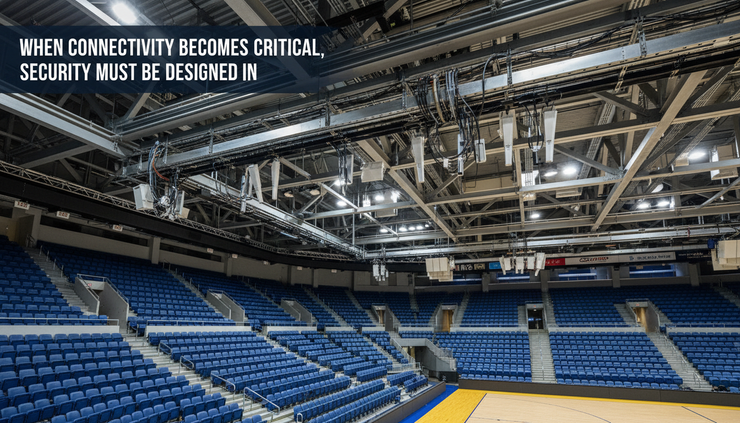
Consider a large venue. On event day, thousands of devices may connect in a short period. Public safety teams may need reliable radio access in stairwells, service corridors, loading docks, and below-grade spaces. Vendors may use wireless point-of-sale devices. Operations teams may use handhelds for ticketing, crowd movement, or facilities support.
The venue may have strong coverage, but the architecture must also make clear which systems connect where, who maintains them, how access is controlled, and how changes are approved.
In a hospital, the stakes are different but the principle is the same. Wireless service may support clinical communication, facilities operations, visitor access, and emergency coordination. Design choices should support IT and security governance without disrupting the workflows the facility depends on.
A secure operational environment is not created by signal alone.
Coordination reduces surprises during construction and operation
Many wireless problems show up late because the right groups were not in the same conversation early enough.
The RF team may understand propagation and capacity. The construction team may understand schedule and access. The IT team may understand network policy. The OT team may understand building systems. The cybersecurity team may understand controls and risk. The operator may understand performance standards and maintenance obligations.
If those perspectives remain separate, gaps appear.
A pathway might be chosen for convenience without accounting for system separation. A room might be assigned without considering access control. A device might be installed in a location that works for RF performance but creates service access issues later. A change in one system might affect another system that was never properly documented.
Good engineering reduces those surprises.
That does not mean every project needs more complexity. It means wireless infrastructure should be planned with enough clarity that every stakeholder can understand what is being built, where it connects, who owns it, and how it will be maintained.
This is especially important in retrofit environments. Hospitals, airports, hotels, commercial towers, and venues often have existing systems layered over many years. New wireless infrastructure must fit into legacy pathways, active operations, limited maintenance windows, and evolving security requirements.
In those environments, assumptions are costly.
Field verification matters. Documentation matters. Testing matters. So does listening to the teams that will live with the system after installation.
Validation should prove more than performance
Testing is often associated with whether the system works. That is necessary, but validation should also support accountability.
A well-executed wireless project should leave behind evidence that the design intent was met. That may include RF test data, acceptance results, as-built documentation, equipment inventories, antenna locations, cabling records, headend details, and clear ownership boundaries.
For security and operations teams, that information is valuable.
It helps them understand the environment they are responsible for protecting. It helps future contractors avoid accidental changes. It helps facility teams plan upgrades without guessing. It gives network operators and enterprise teams a common reference point when performance issues or change requests arise.
Documentation is not paperwork for its own sake.
It is part of the system.
Poor documentation can turn a simple change into an investigation. Clear records help teams act with confidence.
This is also where independent engineering support can be useful. A wireless design and validation partner can help translate between field conditions, RF performance, carrier requirements, construction realities, and enterprise expectations. That role is not to define cybersecurity policy. It is to help make sure the physical and RF design does not work against that policy.
A building can only be managed well if its systems are understood.
Designing for change is part of designing for security
Wireless systems do not stand still.
Carriers evolve networks. Enterprises add applications. Building systems become more connected. Tenants change. Venues alter layouts. Hospitals renovate departments. Airports expand terminals. Hotels upgrade guest and staff services.
Security requirements also change.
A design that works on opening day may need to support new policies, new technologies, and new operating models later. That is why flexibility has to be balanced with control. Extra pathway capacity, well-planned equipment rooms, labeled infrastructure, and documented demarcation points can make future changes easier to manage.
That future state should not depend on memory.
It should depend on design.
When wireless infrastructure is treated as a long-term building system, teams can plan for lifecycle management. They can review access processes. They can coordinate planned upgrades with IT and OT requirements. They can test changes before they affect operations. They can avoid mixing systems simply because there is available space.
The best time to protect future options is before the first installation begins.
This is the practical meaning behind the idea that security must be designed in. It does not mean every RF engineer becomes a cybersecurity analyst. It means the infrastructure design process respects the controls, boundaries, and operational needs that security teams are accountable for maintaining.
The wireless layer deserves a seat at the security table
Cybersecurity Awareness Month is a useful reminder that security is not one team’s responsibility alone. It is a shared discipline across technology, facilities, operations, vendors, and leadership.
Wireless infrastructure belongs in that conversation.
Not because antennas, cables, and headends are security tools by themselves. They are not. They matter because they form part of the connected environment where security policies must work in practice.
For facility owners and developers, that means wireless planning should begin early enough to influence pathways, rooms, construction details, and stakeholder coordination.
For enterprise IT and cybersecurity teams, it means RF and telecom design should be part of the broader technology governance process.
For network operators and carriers, it means performance requirements need to align with site access, system ownership, and documentation expectations.
For consultants and engineers, it means the best design is not only the one that closes coverage gaps. It is the one that fits the building’s operational reality.
Critical connectivity is a design responsibility.

Final Thought
Connectivity is often judged by what users can see: bars on a phone, a working handheld, a connected device, a clear radio transmission.
The stronger measure is what the architecture supports when no one is thinking about it.
Reliable wireless service depends on design. So does maintainability. So does coordination with the security requirements that protect modern facilities and operations.
RAN Wireless approaches wireless infrastructure from that engineering perspective: plan carefully, design with the full environment in mind, validate what is built, and make the system understandable for the teams that depend on it.
When connectivity becomes critical, coverage is only the starting point.
The design has to carry the responsibility behind it.


Comments